Fantastic Beasts and Where to Find Them
Fantastic Beasts and Where to Find ThemFantastic Beasts and Where to Find Them is at once a reference book about magical creatures and, in the edition framed by its introduction, a marked-up copy of Harry Potter’s own book. Commissioned in 1918 and described as being in its fifty-second edition, it builds a mock natural history from creature descriptions, administrative rules, reported incidents and scholarly-looking notes. Its authority is deliberately comic: the catalogue takes its categories and procedures seriously even when its evidence includes a wizard mistaking himself for a ghost after hearing pet birds moan.
Publication and Annotated Copy
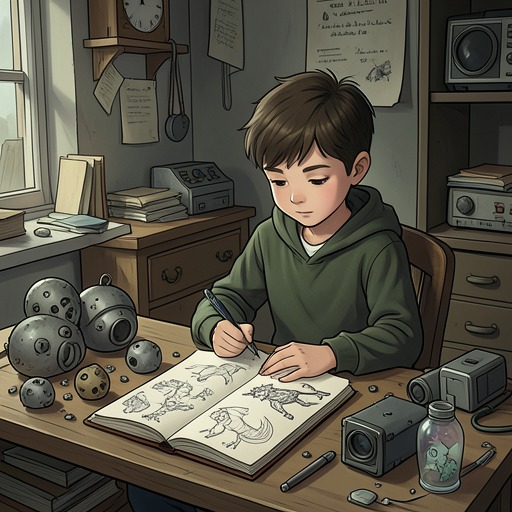
The book’s framing turns an apparently fixed reference work into an object with a history of use. The reprint is described as a duplicate of Harry Potter’s copy, reproduced with his and his friends’ informative marginal notes. Harry seemed reluctant to let the book appear in that form, but the notes were judged likely to add to its entertaining tone. The annotations therefore do more than identify an owner: they set the main text beside readers who answer, supplement or play against its formal authority.
The introduction also makes Newt Scamander’s consent part of the book’s publication story. He had long since resigned himself to his masterpiece being relentlessly graffitied, and agreed to the reprint. The contrast is characteristic of the volume’s double life: a work presented as an authoritative compendium is also a well-used book whose margins invite irreverent intervention.
Commission and Making
The first edition was commissioned in 1918 by Augustus Worme of Obscurus Books. Worme asked Newt Scamander to write an authoritative compendium of magical creatures. Scamander accepted for two connected reasons: the work would augment his salary of two Sickles a week, and it would allow him to spend his holidays travelling the globe in search of new magical species. The book’s encyclopedic form thus grows from a practical publishing commission and a programme of travel and observation.
The introduction presents that beginning as the start of an ongoing publishing history: the book has reached its fifty-second edition. This accumulated history gives the guide an air of durability, but it does not make its contents a detached inventory. The traveller-author’s encounters and the volume’s later notes keep observation, anecdote and editorial framing visible within the reference form.
A Catalogue with Apparatus
The work’s documentary manner is built from more than creature entries. It uses a Ministry of Magic classification scheme, cross-references, footnotes, named authorities, dates and reports of particular encounters. The Ministry’s five-part danger scale, for example, presents magical creatures as subjects that can be sorted according to perceived dangerousness. The numerical order and official label offer a practical vocabulary of risk, while the catalogue’s individual cases expose the oddities and uncertainties that such a system must contain.
An account of the Augurey makes the collision of taxonomy and comic anecdote especially clear. Uric the Oddball is said to have slept in a room with no fewer than fifty pet Augureys. During a particularly wet winter, their moaning convinced him that he had died and become a ghost; his attempts to walk through the walls of his house ended in what his biographer called a concussion lasting ten days. A footnote directs readers to Gulliver Pokeby’s 1824 book, Why I Didn’t Die When the Augurey Cried. The precise number, named biographer and cited title imitate the supports of natural history, while the episode’s absurd consequence makes the reference apparatus part of the joke.
The catalogue also uses place and observation to distinguish beings that may initially appear alike. The world’s largest Kelpie is said to be in Loch Ness, where its favourite form is that of a Sea Serpent. International Confederation of Wizards observers realized it was not a true serpent when they saw it turn into an otter. The report moves from a striking location and familiar appearance to a piece of observational evidence that revises the first impression. Such cases make classification a process of looking again, not simply assigning a name.
Creature Governance and Contested Boundaries
The guide extends its reference function into law and administration. In 1750, Clause 73 was inserted into the International Code of Wizarding Secrecy. It assigns each wizarding governing body responsibility for the concealment, care and control of magical beasts, beings and spirits within its jurisdiction. The provision links creature management to secrecy: beings must be governed not only for their own circumstances but also in relation to the boundary between the wizarding and Muggle worlds.
That responsibility produces substantial institutional work. The Department for the Regulation and Control of Magical Creatures is identified as the Ministry of Magic’s second-largest department, and it deals with creatures that remain conspicuous to Muggles, whether willfully or inadvertently. The scale of the department, and the distinction between deliberate and accidental visibility, make concealment an ongoing administrative problem rather than a rule that automatically resolves every encounter.
The book also records limits to official classification and jurisdiction. Centaurs objected to sharing “being” status with creatures such as hags and vampires and declared that they would manage their own affairs separately from wizards; a year later, the Merpeople made the same request. The Ministry accepted their demands reluctantly. Although a Centaur Liaison Office exists in the Beast Division of the Department for the Regulation and Control of Magical Creatures, no Centaur has ever used it. Within the department, being sent to that office became an in-joke meaning that the person concerned would shortly be fired. The gap between an official liaison structure and its complete non-use turns a piece of bureaucracy into evidence of negotiated separation—and of the institution’s comic awareness of its own failure to make the arrangement work.
Trade and breeding supply another layer of control. The Department for the Regulation and Control of Magical Creatures keeps strict watch on the trade in magical creatures and their young and eggs. The 1965 Ban on Experimental Breeding made the creation of new species illegal. These measures address different points of intervention: the circulation of existing creatures and their offspring, and the deliberate production of new kinds. Together with secrecy requirements and danger classifications, they show a system that attempts to regulate not only what creatures are, but where they may go and whether new ones may be made.
Significance and Tone
Across its apparatus, Fantastic Beasts and Where to Find Them treats the border between knowledge and governance as part of the subject. A danger category, a secrecy rule or a liaison office may look like neutral organization, yet each depends on decisions about who can classify a creature, which beings count as “beings,” and when a community can refuse the terms imposed on it. The Centaurs’ and Merpeople’s demand to manage their own affairs makes that political dimension explicit; the unused liaison office shows how a formal arrangement can remain on the books without becoming a working relationship.
At the same time, the volume’s footnotes and cases prevent its reference voice from becoming wholly impersonal. A wet winter, fifty Augureys, a ten-day concussion and an otter mistaken for evidence of a serpent all bring particular circumstances into a system of general categories. The result is a factual fable: impossible creatures are handled through the sober forms of publishing, classification and administration, while the comic incidents reveal how much those forms depend on fallible observers and unsettled boundaries. In the reprinted annotated copy, Harry Potter and his friends’ marginal notes add another layer to that tension, making the supposedly finished authority of the guide a continuing conversation.